Physician Market Report Q2 2026: What the Data Is Showing Right Now
At-a-glance
In Q2 2026, the physician market saw physician demand remain elevated while active participation fell by 4%, applications dropped by 6%, and new registrations decreased by 7%. Healthcare organizations face a shrinking pool of actively engaged candidates, especially in Hospitalist, Psychiatry, and OB/GYN specialties.
Table of contents
New physician registrations: Supply growth continues to lag
Active physicians: Participation became the biggest shift of the quarter
Physician applications: Engagement softened
Open physician jobs: Demand remains elevated but growth has moderated
Emerging Q2 workforce signals: Supply pressure is becoming more evident
Physician market report Q2 2026 FAQs
Executive summary
Physician market data from Q2 2026 suggest that workforce constraints remain firmly in place, but the drivers of those constraints shifted compared to Q1. While employer demand remained elevated throughout the quarter, physician participation, applications, and new registrations all moved lower, pointing to a tightening talent pool rather than an expanding one.
In Q1, the dominant story was accelerating demand. Open physician jobs climbed steadily, while participation and engagement fluctuated but remained relatively stable. In Q2, demand remained strong but began to level off, while several physician supply indicators weakened simultaneously.
The result is a market that remains highly competitive for healthcare organizations. Demand continues to outpace available physician engagement, particularly in behavioral health, hospital-based specialties, and primary care. While hiring activity remains widespread across the country, fewer physicians appear to be actively participating in the market compared to earlier in the year.
Taken together, Q2 reinforces a key theme from Q1: physician staffing challenges remain structural rather than temporary. However, the gap between demand and available supply appears to be widening as physician engagement and new market entry soften.
Key Q2 signals
- Open physician jobs remained elevated throughout the quarter, ending Q2 near April levels after peaking in May
- Active physician participation declined approximately 4% during Q2, compared to the relative stability in Q1
- Physician applications declined 6% over the quarter, reversing the rebound observed during Q1
- New physician registrations fell from April to June, indicating weaker new physician inflow
How to interpret physician recruitment data in Q2
The physician labor market is best understood by evaluating multiple indicators together rather than relying on any single metric.
The four datasets below provide different perspectives on workforce supply and demand:
- New physician registrations → new physician inflow
- Active physicians → currently engaged physician supply
- Applications → physician interest in pursuing opportunities
- Open jobs → hiring demand from healthcare organizations
Compared with Q1, the most significant change was not a surge in demand, but a decline in supply engagement. Demand remained elevated, but participation, applications, and registrations all moved lower throughout the quarter. Viewed collectively, the Q2 data suggests healthcare organizations are competing for a smaller pool of actively engaged physicians.
New physician registrations: Supply growth continues to lag
New physician registrations declined approximately 7% during Q2 and finished the quarter below both April and May levels.
This reinforces a trend already visible in Q1, when registrations declined month-over-month and remained below January’s seasonal peak. Rather than recovering in Q2, new physician inflow weakened further.
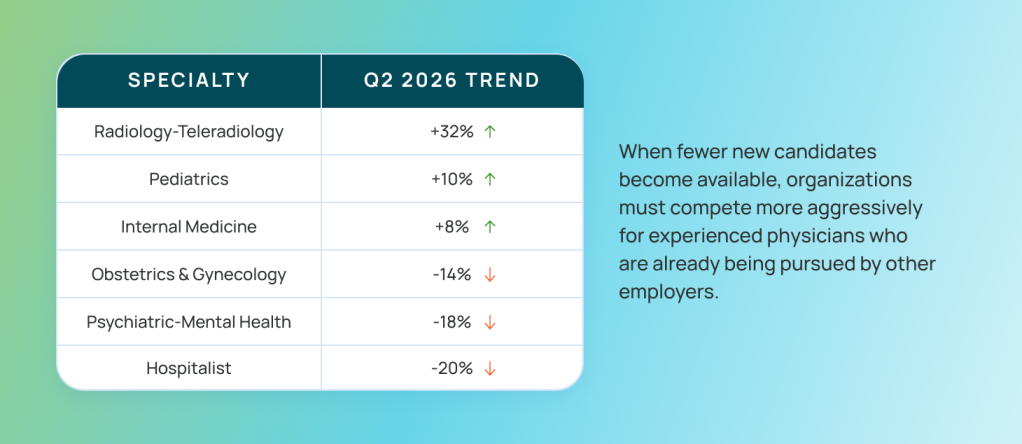
Several specialties posted gains during the quarter, including:
What changed from Q1?
Q1 physician market data suggested new physician supply fluctuated but not improving. Q2 reinforces that concern, with registrations ending the quarter lower than where they began. The data suggests healthcare organizations should not expect meaningful expansion in physician supply through new market entrants alone.
Why this matters for healthcare organizations
A decline in new physician registrations reduces the number of clinicians entering the active recruitment market. When fewer new candidates become available, organizations must compete more aggressively for experienced physicians who are already being pursued by other employers. This can contribute to longer vacancy periods, increased recruitment costs, and greater difficulty filling hard-to-staff specialties such as Hospitalist, Psychiatry, and Obstetrics & Gynecology. Organizations relying on future physician supply growth to ease recruiting pressures may not see meaningful relief in the near term.
Active physicians: Participation became the biggest shift of the quarter
Active physician participation declined roughly 4% during Q2. This marks a notable shift from Q1, when participation stabilized after early-year declines and showed relatively modest month-to-month movement.
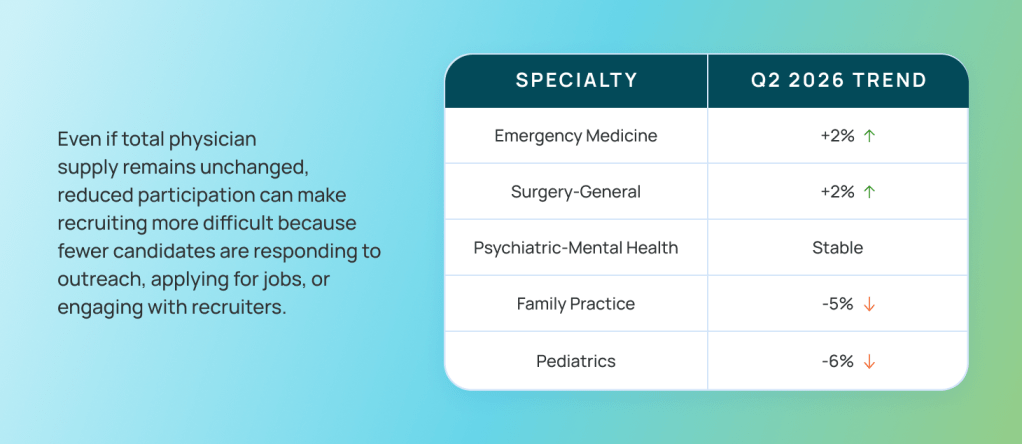
Two large physician specialties experienced declining participation:
- Family Practice declined by 5%
- Pediatrics declined by 6%
Several specialties demonstrated greater resilience:
What changed from Q1?
While Q1 showed a physician workforce that was largely holding steady, Q2 showed physicians becoming less active overall. This suggests the available talent pool may be tightening even before demand materially declines.
Why this matters for healthcare organizations
Active physician participation is one of the strongest indicators of the immediately available talent pool. When participation declines, employers effectively have fewer physicians actively exploring opportunities. Even if total physician supply remains unchanged, reduced participation can make recruiting more difficult because fewer candidates are responding to outreach, applying for jobs, or engaging with recruiters. This may increase time-to-fill for critical positions and place additional strain on existing clinical teams.
Physician applications: Engagement softened
Physician application activity declined approximately 6% between April and June.
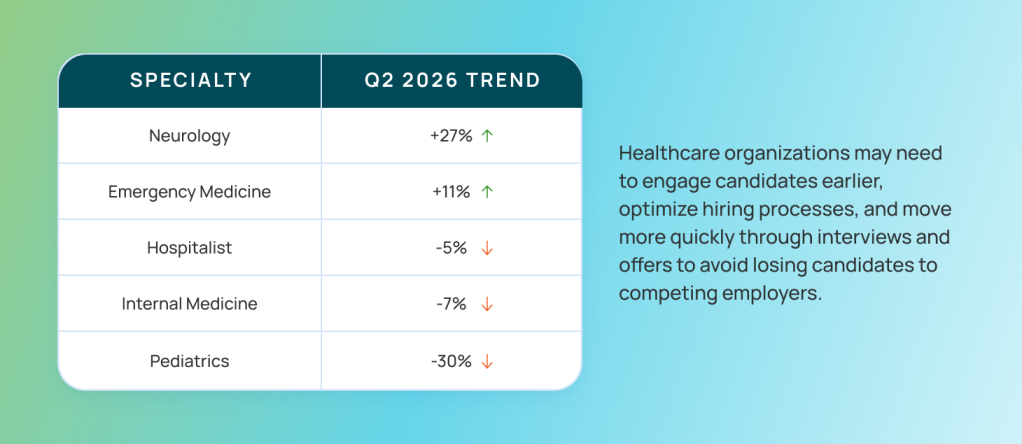
Several major specialties experienced reduced engagement:
What changed from Q1?
This data set shows one of the clearest contrasts between quarters. Q1 was characterized by application rebounds in several specialties, including Family Practice, Pediatrics, and Internal Medicine. Q2 reversed that trend, with application activity declining across much of the market.
Rather than widespread provider engagement, Q2 application growth was concentrated within a smaller number of specialties.
Why this matters for healthcare organizations
Application activity provides insight into physician willingness to pursue new opportunities. Lower application volume typically translates into smaller candidate pipelines and reduced recruiting efficiency. Healthcare organizations may need to engage candidates earlier, optimize hiring processes, and move more quickly through interviews and offers to avoid losing candidates to competing employers. The decline is particularly meaningful in high-demand specialties, where even modest reductions in physician engagement can significantly impact hiring outcomes.
Open physician jobs: Demand remains elevated but growth has moderated
Open physician jobs remained historically elevated throughout Q2, although growth slowed compared to the stronger upward trajectory observed during Q1.
Demand growth remained strongest in:
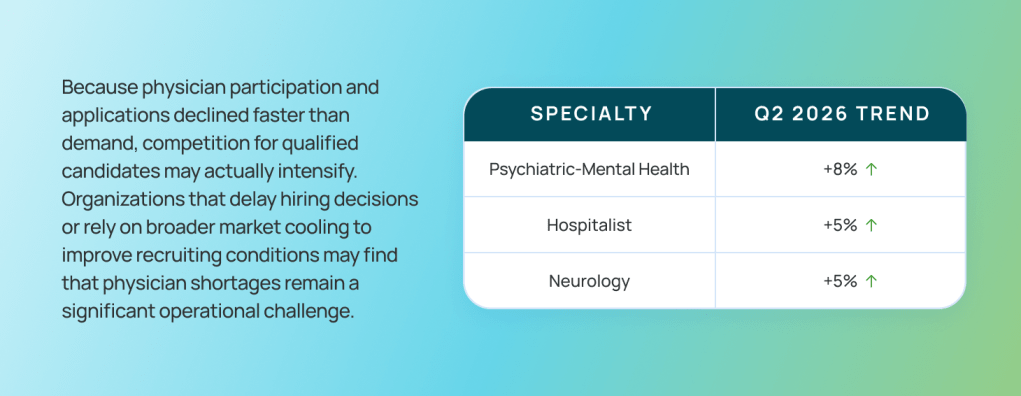
Emergency Medicine and Family Practice remained among the largest recruiting categories, while demand softened late in the quarter for specialties such as Anesthesiology, Obstetrics & Gynecology, and Gastroenterology.
What changed from Q1?
In Q1, open jobs were the strongest growth signal in the market, with demand consistently increasing month after month. In Q2, demand remained elevated but no longer accelerated at the same pace. Instead, the market appears to be transitioning from rapid expansion to sustained high demand.
Importantly, demand did not fall nearly as quickly as physician participation and engagement, which means recruiting competition remains intense despite slower job growth.
Why this matters for healthcare organizations
The moderation in job growth should not be interpreted as a meaningful easing of physician workforce pressures. While demand growth has slowed, the number of recruiting organizations competing for physicians remains historically high. Because physician participation and applications declined faster than demand, competition for qualified candidates may actually intensify. Organizations that delay hiring decisions or rely on broader market cooling to improve recruiting conditions may find that physician shortages remain a significant operational challenge.
Struggling with declining application volumes?
Schedule a Consultation
to see how our physician staffing experts can help you optimize your hiring pipeline.
Emerging Q2 workforce signals: Supply pressure is becoming more evident
Q1 highlighted persistent demand while Q2 highlighted shrinking physician engagement. Active participation, applications, and registrations all moved lower during the quarter, indicating supply constraints may be becoming more pronounced.
Behavioral health remains a growth area
Psychiatric-Mental Health continued to show growth in demand while maintaining relatively stable participation and application trends compared with many other specialties.
Hospital-based recruitment remains highly competitive
Hospitalist and Emergency Medicine continue to represent some of the strongest sources of recruiting demand.
Geographic patterns remain remarkably stable
The leading states for both physician demand and engagement changed very little throughout Q2. Recruitment challenges continue to be broadly distributed across the country rather than concentrated in a handful of regions.
Final Takeaways
Compared with Q1, Q2 was less about growing demand and more about declining supply engagement.
Demand remained strong, but physician participation declined approximately 4%, applications fell approximately 6%, and new physician registrations decreased approximately 7% during the quarter. Meanwhile, demand remained elevated across many of the specialties most critical to healthcare system capacity.
For healthcare organizations, the challenge is increasingly not whether demand exists but competing for a physician workforce that appears less active, less engaged, and slower to expand than the market requires.
The physician market remains in motion and Q2 data suggests that while demand may be stabilizing, physician supply growth is not keeping pace, reinforcing many of the structural workforce challenges healthcare organizations have been managing throughout 2026.
Physician market report Q2 2026 FAQs
What was the biggest shift in the physician market during Q2 2026?
The most significant change was a decline in supply engagement, as active physician participation fell by approximately 4%, applications dropped by 6%, and new registrations decreased by 7%.
Are physician supply shortages expected to improve later in 2026?
Current data indicates that healthcare organizations should not expect meaningful expansion through new market entrants alone, as new physician registrations finished Q2 lower than where they began.
Which medical specialties saw the biggest drop in new registrations in Q2 2026?
Declines were notable across several coverage-critical specialties, including Hospitalist (-20%), Psychiatric-Mental Health (-18%), and Obstetrics & Gynecology (-14%).
Did any specialties see an increase in physician applications during Q2?
Yes, while overall applications dropped, Neurology experienced a significant 27% jump from May to June, and Emergency Medicine applications increased by 11%.
How did physician job demand change from Q1 to Q2 2026?
Open physician jobs remained historically elevated, ending Q2 near April levels. However, the rapid demand growth seen in Q1 leveled off, transitioning into sustained high demand.
Why is the decline in active physician participation a problem for employers?
When participation declines, fewer candidates respond to outreach, apply for jobs, or engage with recruiters, which can increase time-to-fill for critical positions.
Are physician recruitment challenges isolated to specific U.S. regions?
No, geographic patterns remained remarkably stable throughout Q2, indicating that recruitment challenges are broadly distributed across the country rather than concentrated in specific areas.
What should healthcare organizations do in response to lower physician application volumes?
Organizations should engage candidates earlier, optimize their hiring processes, and move quickly through interviews and offers to avoid losing talent to competitors.
Which specialties are currently the most competitive for hospital-based recruitment?
Hospitalist and Emergency Medicine continue to represent some of the strongest sources of recruiting demand for hospital-based roles.
Is behavioral health still a growing area for physician recruitment?
Yes, Psychiatric-Mental Health continued to show demand growth (8%) in Q2 while maintaining relatively stable participation and application trends compared to other specialties.
Methodology & Data Source: This Q2 2026 report analyzes data spanning April through June 2026, evaluating new physician registrations, active physician participation, physician applications, and open job postings across the United States to assess workforce supply and demand.
 Lompoc Vision: New school year, new students, new possibilities