Hospitals face sustained workforce pressures including long-term staffing shortages, rising labor costs, shifting reimbursements and thin margins. This makes workforce innovation a top priority. Aya has conducted its first research study of workforce innovation, combining a national survey of hospital leaders with focused interviews.
Highlights
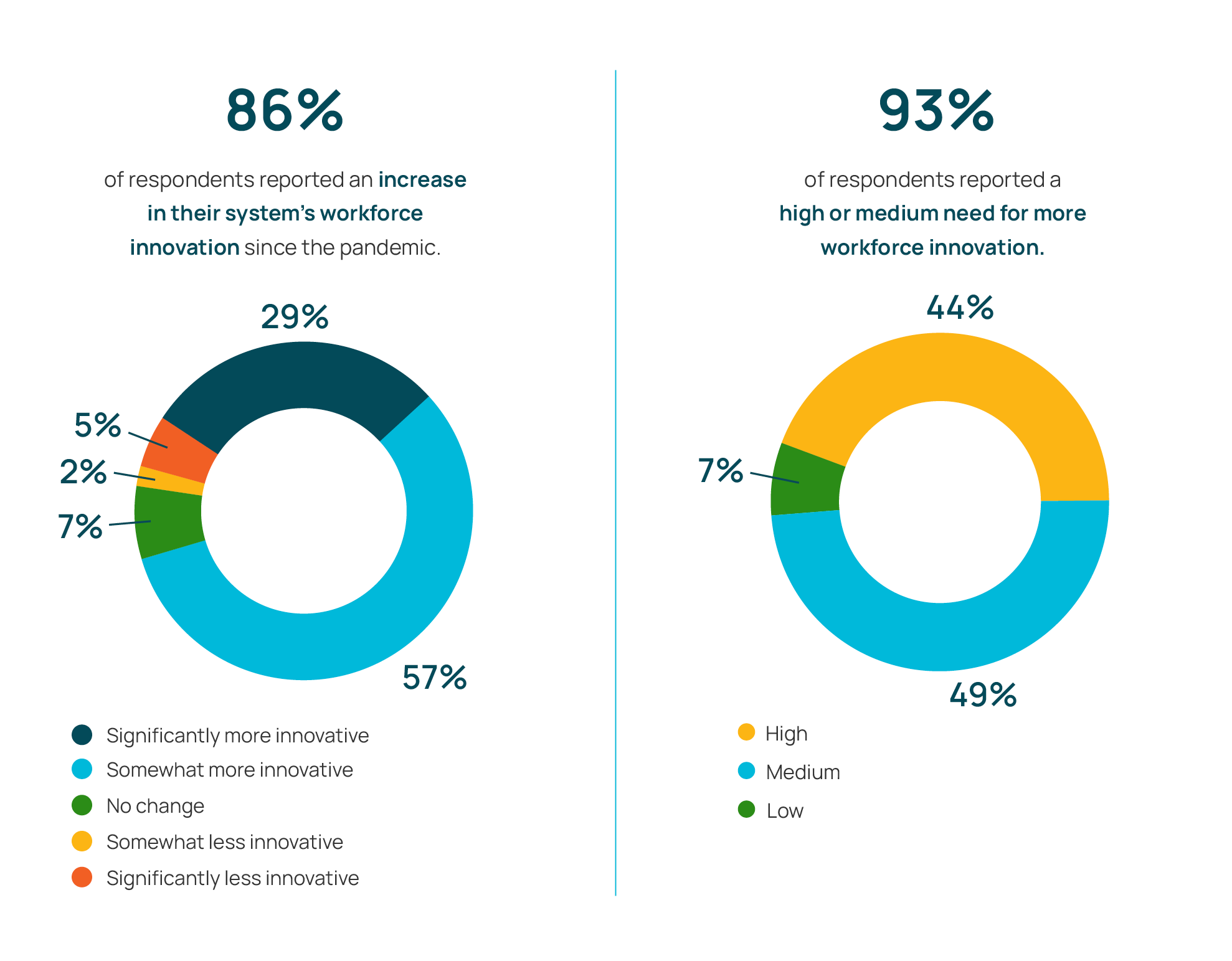
Workforce innovation is up, but more progress is needed. Despite 86% of leaders reporting increased workforce innovation since the pandemic, nearly all leaders (93%) still report a medium/high need for innovative workforce strategies, signaling progress, but more remains to be done. Efforts that improve day-to-day workforce sustainability will matter most going forward.
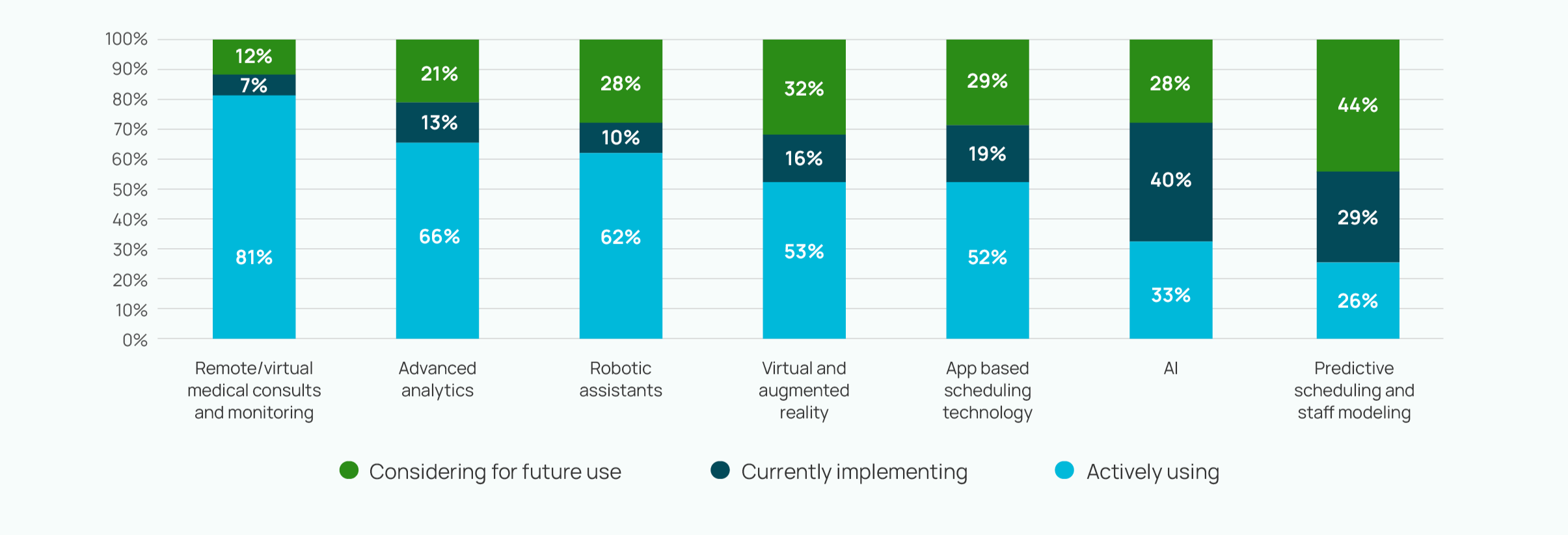
Technology interest outpaces operational readiness. While established tech like virtual care is widely adopted, newer capabilities like AI and predictive scheduling remain limited in active use. Clear ownership and workflow alignment are critical to translating new technology into value.
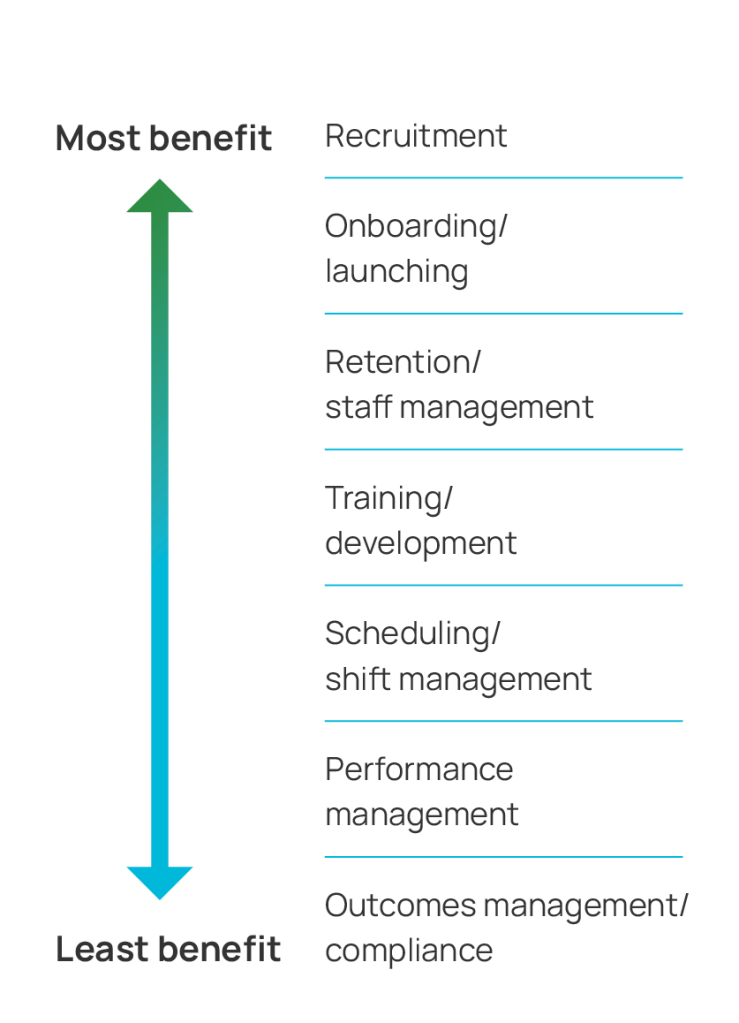
Innovative practices are concentrated in hiring, not daily operations. Recruitment and onboarding currently dominate innovation priorities, while scheduling and shift management lag despite their direct impact on capacity, cost and staff experience. Expanding focus to operational workflows can unlock greater system-wide benefits.
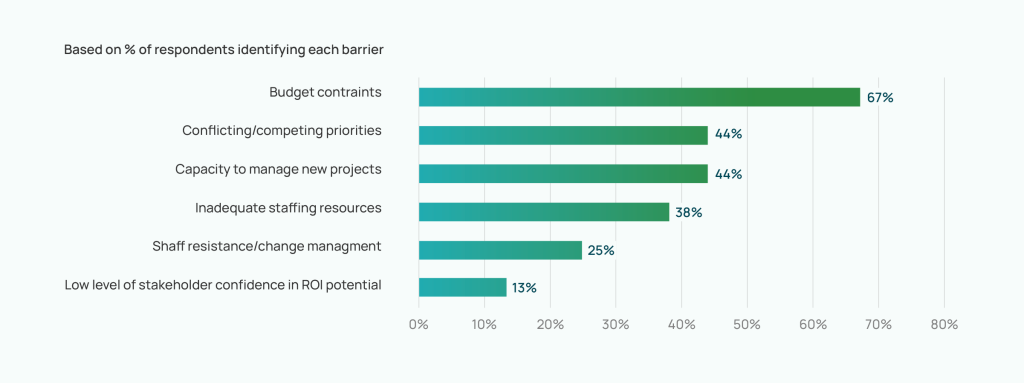
Ideas aren’t the issue. Bandwidth is. Budget pressures, competing priorities and limited internal resources constrain progress. Innovative ideas advance when teams have time, clear ownership and measurable operational goals.
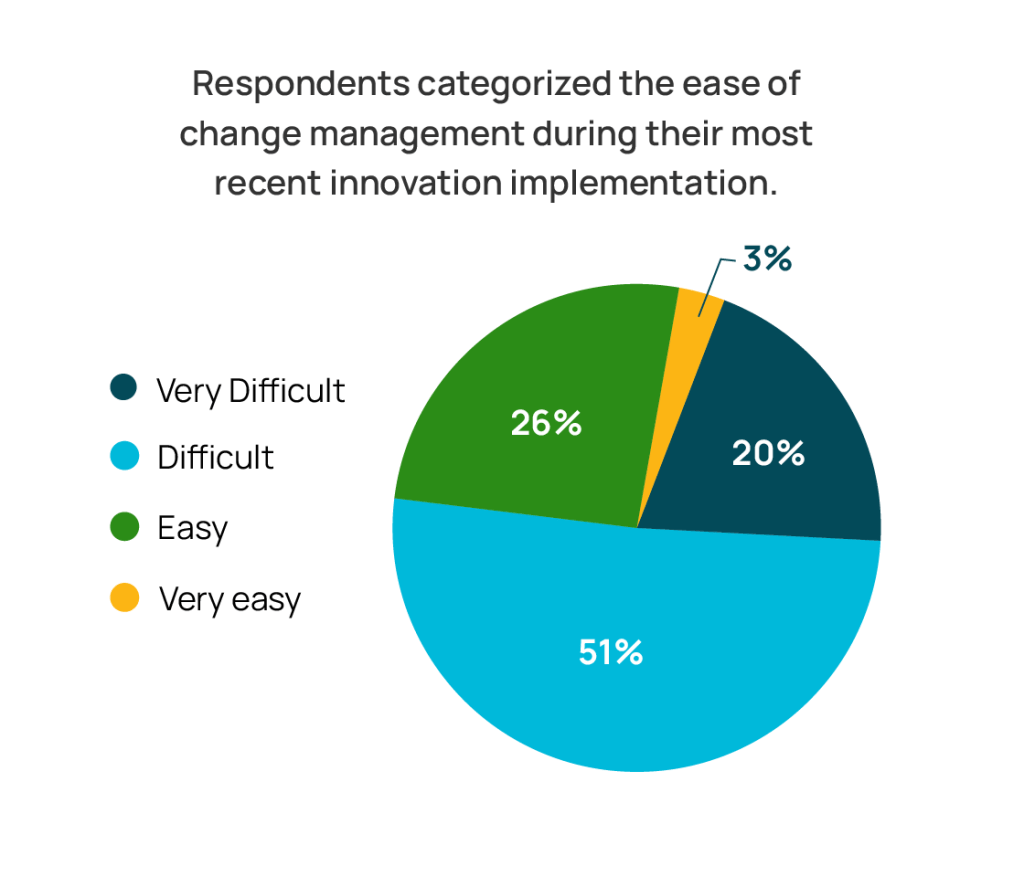
Adoption is where most efforts break down. Seventy-one percent of leaders report difficulty with change management, underscoring the importance of engaging end users early and demonstrating value.
Health system leader perspective
Learn practical strategies to drive change in this webinar with survey respondent Kate Colfer, Director of Workforce Planning at Northwestern Medicine, and Arvin Juan, Division VP of Program Management at Aya Healthcare.
In 2025, Aya Healthcare set out to understand how hospitals are solving workforce challenges differently. Healthcare organizations face sustained workforce pressures: projected long-term shortages of RNs and other disciplines, rising wage costs, a shifting reimbursement landscape and thin operating margins. Even as turnover and vacancy rates show signs of improvement, the day-to-day reality is that workforce strain still drives operational risk and financial volatility, making innovation an operational imperative, not a “nice to have.”
While most health systems surveyed (86%) reported an increase in their system’s workforce innovation since the pandemic, there is still a large appetite for change. A full 93% of respondents reported a high or medium need for more workforce innovation.
This report reflects what we learned from hospital leaders through our national survey, interviews and in-depth research. Respondents shared their insights on where change is needed, what’s already in motion and how to make impacts that last.
The opportunity map: where innovation matters most
When leaders were asked where innovation would make the biggest difference, they pointed first to the workforce lifecycle: recruitment, onboarding/launching, and retention /staff management.
“Recruitment is way harder than onboarding. Getting the right people comes first, but training and development can be automated to close the gaps.”
Next were practical levers that shape daily experience and capacity: training/development, followed by scheduling/shift management. Areas like performance management and outcomes/compliance were viewed as lower priorities compared with the core talent and operations challenges leaders are trying to solve right now.
Hiring with a long-term lens
Leaders described a shift from filling open roles to building a pipeline that makes it easier for people to enter, grow and stay, especially for hard-to-fill areas.
“We’re recruiting people into a front-door career opportunity, not just a frontline job.”
Talent acquisition AVP, interview participant
This long-term view shows up in the practical moves leaders prioritize: clear career pathways, refreshed onboarding processes and retention practices that reduce churn and keep teams stable once the right people are in the door.
Turning priorities into action
Across interviews, leaders emphasized that the hardest part of workforce innovation isn’t generating ideas, it’s translating priorities into something teams can execute day to day.
“The age-old issue is how you make an idea into an actual thing.”
Talent acquisition AVP, interview participant
Aligning with operations
Interviewees described an alignment gap: some organizations lead in clinical innovation but struggle to translate that strength into workforce operations.
“We’re an academic medical center and clinically innovative, but how do we become organizationally innovative, as well?”
Day to day, this shows up as advanced clinical programs running alongside workforce systems that are still manual and fragmented. Scheduling practices vary by unit and staffing decisions are often made with inconsistent data. Over time, that mismatch creates avoidable variability that makes it harder to scale improvements across the organization.
“Innovation is part of our identity and values, but when you look at talent, we’re not very innovative yet.”
Talent acquisition AVP, interview participant
In addition to clinical and operational misalignment, leaders also discussed challenges of aligning operational processes with new technologies. While technology is an integral part of how an organization runs, respondents were clear that the value depends on how the technology is introduced.
New tools require new workflows to support adoption, such as roles, responsibilities and decision paths. This dynamic helps explain the mixed adoption picture in the survey: more established capabilities like virtual care and advanced analytics are widely adopted, while newer or less embedded tools like AI and predictive scheduling lag in active use.
Technologies by adoption status
What’s at stake is significant. A McKinsey/Harvard analysis estimates that scaling AI across U.S. hospital operations could drive down costs by 5-10%, with savings of up to $120B annually. Leaders also pointed to a concrete opportunity: using data and AI to bring more structure and predictability to workforce planning, including high-value areas like scheduling and staffing.
“AI might be tech, but for me it’s really about strategy … the journey we’re going down is to build a strategy around workforce planning using data and AI.”
“The project nearest to my heart is using predictive technology to standardize nursing staffing and scheduling — benchmarking how good or bad we are against the city and the nation.”
Executive director of nursing workforce and clinical ops, interview participant
What to do: Align tools and resources to high-impact workflows
Define 1-2 high-value use cases where AI and analytics can improve reliability (e.g., staffing and scheduling).
Outline the operating changes that make the tool usable day to day: who owns it, how it supports decision making and which workflows will change.
Leverage innovation infrastructure from non-workforce areas to unlock resources and know-how that can fuel operational improvements.
Pilot in one area where the workflow is already structured (e.g., units with centralized scheduling) and then scale once impact is consistent.
Measure outcomes tied to workforce and operations: schedule stability, premium labor use and time returned to care.
Capacity: The gatekeeper to innovation
The survey and interviews revealed that the biggest constraint wasn’t ideas, it was capacity: limited budgets, competing priorities and not enough people-hours to take on additional projects. The takeaway is simple: innovation often stalls when teams lack the resources and room to drive change forward.
“Budget is always the number one barrier, but even I was surprised to see inadequate staffing resources holding back strategy implementation.”
Leaders described innovation work as something that often sits “off to the side”. It is important but not consistently resourced or protected. That dynamic can leave initiatives stuck between teams or stalled as operational priorities emerge.
“There are so many competing priorities; everyone’s trying to run in the same direction, but it doesn’t always happen.”
Talent acquisition AVP, interview participant
What to do: Set the table for innovation
Block weekly time for a small team to work on workforce improvements.
Convert persistent problems into a one-pager: problem, solution, value and 2-3 sponsor-relevant metrics.
Assign a project owner to drive the work.
Set clear decision points so projects don’t stall when operational priorities arise.
Change management: The path from pilot to practice
Making room for innovation is the first hurdle. Getting people to adopt it is the next. In our survey, 71% of respondents rated change management for their most recent workforce innovation as difficult or very difficult, underscoring how hard it can be to move from ideation to real adoption.
Implementations were difficult due to stakeholder buy-in and resistance to change from all levels.”
Nursing supervisor, survey respondent
Leaders emphasized that buy-in starts well before implementation. Involving staff early helps align ideas with workflow realities, reduce resistance and build shared ownership for the change.
“Engaging frontline staff and end users in the process from the beginning [is essential].”
Nursing executive, survey respondent
Survey respondents also pointed out that readiness can vary widely across units and teams. Even with a solid plan, adoption can lag when general awareness is low, leader buy-in is inconsistent, or frontline teams need more support to use new tools and processes.
“We launched SkillSoft and integrated it with Workday. General awareness and leader adoption and ownership are the biggest challenges. Computer literacy of our frontline staff is another challenge. We learned we cannot reach everyone and may need to adjust our expectations.”
HR director, survey respondent
“We’re trying to bridge that [adoption] gap by offering mentoring and coaching that has never happened before.”
Talent acquisition AVP, interview participant
Sponsor relevant metrics and showing how it compares to peers, help leaders and skeptical stakeholders see what’s working, what isn’t and whether the effort is worth scaling. That clarity can turn adoption from a debate into a decision.
What to do: Build with users, then prove it works
Bring frontline staff and users into the development process early.
Use their input to pressure-test changes against day-to-day realities.
Designate clear owners for rollout and sustainment so adoption doesn’t falter midstream.
Match support to readiness by unit and adjust training and expectations based on skill level.
Create a simple scorecard of 2-3 metrics plus benchmarks, so leaders can see value and make decisions to scale or pivot.
Conclusion
Hospital leaders are not short on novel approaches or urgency. The need for workforce innovation is clear, and the priorities are practical: strengthen recruitment and onboarding, reduce churn, and make scheduling and staffing more reliable. But across the survey and interviews, one message came through consistently: progress depends less on any single tool and more on the conditions that allow innovation to move from intent to impact.
Three takeaways stand out:
Innovation must land in operations. Technology can be a powerful lever, but its impact depends on how well it fits real workflows: who owns it, the decisions it supports and what changes day to day.
Capacity is the gatekeeper. Many initiatives don’t fail at proof of concept; they stall when there isn’t enough time, resources or focus to drive them alongside operational demands.
Adoption is the path forward. Change management is often the longest part of the journey. Buy-in starts early and grows when users are engaged and stakeholders see proof of value.
Workforce pressures will remain a defining operational challenge for hospitals. The organizations that make consistent progress won’t be the ones with the greatest ideas, but the ones that create the capacity, alignment and discipline to make innovation stick.
About our research
From spring to summer 2025, we conducted a mixed-methods study across U.S. hospitals, combining a national survey (53 respondents representing 43 hospitals across 23 jurisdictions) with 7 leadership interviews, supported by targeted literature and case reviews. We examined workforce innovation across two lanes: technology-enabled solutions (AI, automation, virtual care) and operating-model advancements (governance, role clarity, and workflow redesign). The study centered on two questions: (1) what approaches hospitals are using to address workforce sufficiency and operational efficiency, and (2) how clinical teams contribute to developing, implementing and measuring innovations that improve workflow, safety and patient outcomes.
Healthcare workforce innovation FAQs
Where should hospital leaders focus workforce innovation efforts first?
Leaders report that innovation can drive the biggest impact in the early stages of the workforce lifecycle, specifically recruitment, onboarding, and retention. However, there is a growing opportunity to drive value in day-to-day operations, such as scheduling and shift management, which directly affect cost, capacity and staff experience.
What is preventing hospitals from moving faster on workforce innovation?
The biggest barrier is not a lack of ideas. It is capacity. Budget constraints, competing priorities and limited internal resources often prevent teams from executing and scaling new initiatives effectively.
How do we create time and space for innovation when our teams are already stretched?
Leaders highlight the need to purposefully budget time and resources to set the table for innovation. For example, assign a small, dedicated team, protect time for innovation work and prioritize initiatives tied to clear operational outcomes.
How can you ensure new technology actually delivers value?
Technology alone is not enough. Success depends on how well it aligns with operational workflows. Organizations need unified vision, early stakeholder engagement, clear ownership and defined processes to translate tools like AI or predictive scheduling into measurable impact.
Why is change management so challenging in workforce initiatives?
Seventy-one percent of leaders report difficulty with change management. Adoption often breaks down when frontline staff are not engaged early, workflows are not aligned or there is limited visibility into the value of the change.
How should hospitals approach implementing workforce innovation?
Start with one or two high impact use cases such as staffing or scheduling. Pilot in a structured environment and scale once results are proven. Clearly define ownership, workflows and success metrics before expanding.
What does it take to make workforce innovation stick long term?
Innovation requires more than new ideas. Leaders can drive sustainable innovation when they create the capacity to execute, align technology with operations and set the table for adoption.
How can I learn more about healthcare workforce innovation or showcase an innovative workforce initiative?
 Healthcare Brew: This Chicago health system uses LotusOne to cut staffing costs